Ever hung something on a wall and known instantly that it was wrong?
The artwork is lovely. The frame is lovely. But now the room just looks weird… and no one can figure out why.
Nine times out of ten the problem isn’t taste. It’s scale.
Scale is merely the ratio between your artwork and the wall it hangs on. Nail it and a room feels complete. Ignore it and the entire space looks like it was unpacked last Tuesday.
Here’s how to get it right…
Here’s what’s coming up:
- Why Scale Beats Style Every Time
- The Two-Thirds Rule (And When To Break It)
- Sizing A Photo Collage Canvas For Any Wall
- Matching Decor To The Room
- Scale Mistakes That Quietly Ruin A Wall
Why Scale Beats Style Every Time
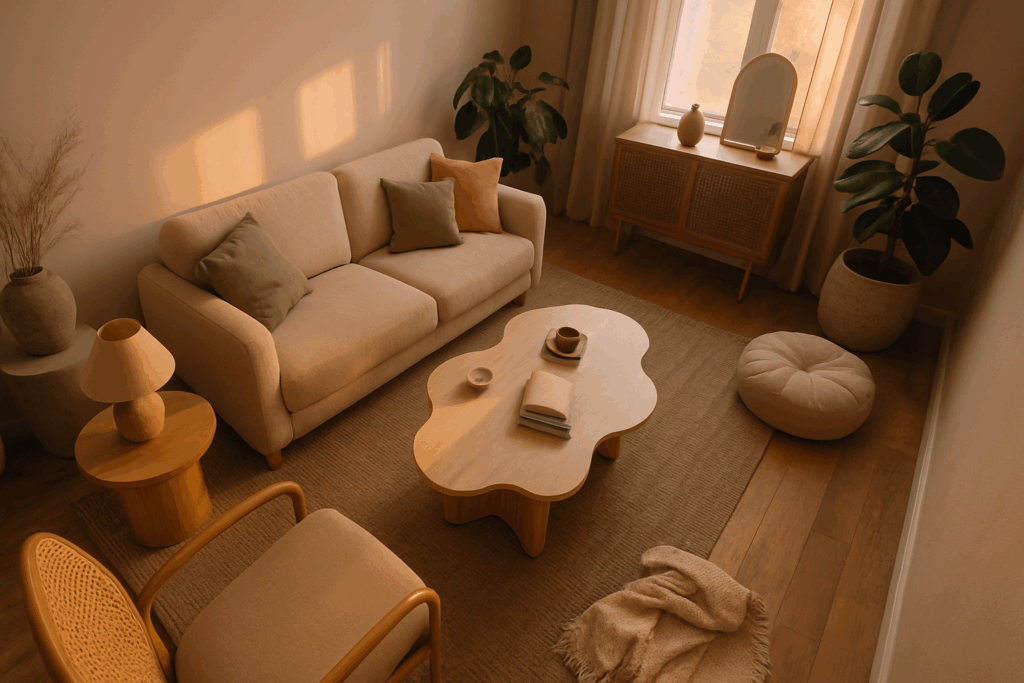
Walk into a room that has correctly scaled art and something just works. The wall seems purposeful. The sofa looks weighted. The room feels larger than it actually is.
Picture walking into a room that has one small frame hanging in the center of a wide empty wall. You see the white space before you notice the art. Wrong way around. This occurs all the time.
Nobody likes to admit it, but it embarrasses people too. In one survey conducted with 2,000 homeowners, 69% admitted they were embarrassed at how their home looked to guests — and hanging artwork was one of the small upgrades they could make that would have the biggest impact.
So walls matter. A lot.
Best of all: scale is inexpensive to fix. A large print, gallery grouping done as you design it or a photo collage canvas made from your family photos can make over a room in a few hours. Today, canvas prints are printed to order in nearly any size you want. So your photo collage canvas can be custom made to fit your wall instead of forcing your photos to fit some predetermined size that just happens to fit on a shelf.
That one little tweak — making the art fit the wall instead of vice versa — does most of the work.
The Two-Thirds Rule (And When To Break It)
Designers disagree about plenty. This one they agree on.
Rule: Wall decorations should occupy approximately two-thirds to three-quarters of your available wall space.
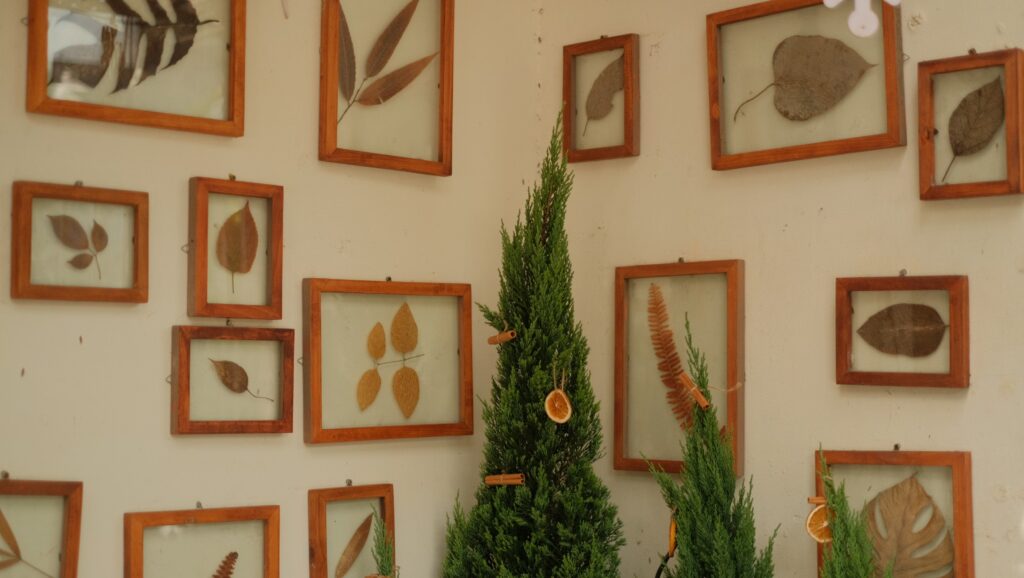
Assuming your sofa is 90″ wide, the artwork above it should fall between 60″ and 68″ wide. This could be a single piece or a gallery that totals 60-68″ when you measure frame edges to frame edges, including the space in between frames.
When hanging art on a blank wall with no furniture below, cover about 60% to 75% of your viewable space and allow for some visual clearance around the perimeter. Allow art to have some space and don’t crowd it into corners.
A quick way to work out your range:
- Measure the wall (or the furniture below it) in inches
- Multiply that number by 0.66 for your minimum
- Multiply it by 0.75 for your maximum
- Shop inside that range and stop second-guessing
So when do you break the rule? Two situations.
The first is a wall with good bones. Fireplaces, wide windows and panelling already have visual weight, so artwork can scale down without the wall looking sparse. The second is a room that is genuinely small, where an oversized piece makes the room feel more cramped than it actually is.
Everywhere else, bigger usually wins.
Sizing A Photo Collage Canvas For Any Wall
Photo collage canvas is one of the simplest methods to cover a big wall without breaking the bank. Instead of searching for one large piece of art, you merge 5, 9 or 20 photos together in one configuration that appears to be one large piece when you view it from across the room.
That last part is the whole trick. One big object.
Here’s how it works: fractured little frames demand your eye hop across them. The collage holds everything to one form with one distinct edge. So the wall itself ends up shouldering enough visual weight while the photos maintain their intimacy. Which is partially why canvas just won’t quit taking up 23.8% of the market share in wall decor.
Sizing a photo collage canvas comes down to three decisions:
- Total dimensions — calculate your two-thirds range first, then choose the measurement closest to that range
- Number of photos — more photos means smaller prints. Limit your selection to what you can recognize when you first walk in the door.
- Orientation — orientate yourself with the shape of the wall, not your favourite photo
40 x 30 inches with 9 to 12 photos is a safe bet above a typical living room sofa. Scale up wider for a king bed: something close to 60 x 30 inches. For example, in a narrow hallway, something tall and vertical, like 20 x 40 inches fills the space without bumping into the door trim.
Rule that no one talks about? Stand back at normal viewing distance. If you can’t recognize a face at that distance, you’ve included too many photos.
Matching Decor To The Room
Every room asks for something slightly different.
Living Rooms
Here’s where scale goes wrong most frequently. Living room walls are large, ceilings are tall, and one 16 x 20 print hung above a sectional sofa looks like a postage stamp. Either hang things large or group several pieces into one large block.
Bedrooms
Art hung above the bed should not extend beyond the width of the mattress on either side. Leave 6 to 8 inches between the top of the art and the headboard so they appear to be one piece.
Hallways And Entryways
You view narrow areas from several feet away, so detail matters. Vertical staging and compact clusters work effectively in a hallway.
Kitchens And Small Spaces
Scale down, just don’t scale to nothing. Having two or three medium groups in a row always wins against a single frame.
Scale Mistakes That Quietly Ruin A Wall
Most of these are easy to fix once you spot them:
- Hanging too high. Centre most pieces 57″ to 60″ from the floor. Hang over furniture 4″ to 8″ above the top of the furniture.
- Leaving big gaps between frames. Two to three inches is plenty if you’re grouping them. Any more space than that and it’s not considered a group.
- Buying the frame before measuring the wall. Measure first. Always.
- Hiding behind furniture. Art on top of a console is ONLY for that console, not for the whole wall.
- Thinking every wall should be treated equally. Stairwells and powder rooms require drastically different approaches.
It’s not rocket science, pull out a tape measure, do some multiplication, and most of these issues vanish before the hammer even drops.
Bringing It All Together
Scale is the element of wall decor that you notice straight away but seldom identify. And it’s 100% manageable with a tape measure and some forethought.
To quickly recap:
- Cover two-thirds to three-quarters of the usable wall
- Treat groupings and collages as one single object
- Size the art to the wall, never the wall to the art
- Hang it lower than instinct says
- Step back and check it from where people actually stand
Do that and it won’t feel incomplete anymore. Which, in the end, is the whole point.
 Ask Donel Robertsonail how they got into diy home improvement ideas and you'll probably get a longer answer than you expected. The short version: Donel started doing it, got genuinely hooked, and at some point realized they had accumulated enough hard-won knowledge that it would be a waste not to share it. So they started writing.
What makes Donel worth reading is that they skips the obvious stuff. Nobody needs another surface-level take on DIY Home Improvement Ideas, Outdoor Living Solutions, Essential Gardening Tips. What readers actually want is the nuance — the part that only becomes clear after you've made a few mistakes and figured out why. That's the territory Donel operates in. The writing is direct, occasionally blunt, and always built around what's actually true rather than what sounds good in an article. They has little patience for filler, which means they's pieces tend to be denser with real information than the average post on the same subject.
Donel doesn't write to impress anyone. They writes because they has things to say that they genuinely thinks people should hear. That motivation — basic as it sounds — produces something noticeably different from content written for clicks or word count. Readers pick up on it. The comments on Donel's work tend to reflect that.
Ask Donel Robertsonail how they got into diy home improvement ideas and you'll probably get a longer answer than you expected. The short version: Donel started doing it, got genuinely hooked, and at some point realized they had accumulated enough hard-won knowledge that it would be a waste not to share it. So they started writing.
What makes Donel worth reading is that they skips the obvious stuff. Nobody needs another surface-level take on DIY Home Improvement Ideas, Outdoor Living Solutions, Essential Gardening Tips. What readers actually want is the nuance — the part that only becomes clear after you've made a few mistakes and figured out why. That's the territory Donel operates in. The writing is direct, occasionally blunt, and always built around what's actually true rather than what sounds good in an article. They has little patience for filler, which means they's pieces tend to be denser with real information than the average post on the same subject.
Donel doesn't write to impress anyone. They writes because they has things to say that they genuinely thinks people should hear. That motivation — basic as it sounds — produces something noticeably different from content written for clicks or word count. Readers pick up on it. The comments on Donel's work tend to reflect that.