
Before ability bars and adrenaline, RuneScape fights depended on weapon speed, prayers, and well-timed special attacks. A quick equipment switch could turn a losing duel around.
That style still has an audience. A new RSPS can bring back combat from an era with simple controls, but mastery took time. Learn what defined that era, and you’ll know which server features are worth trying.
What Does Pre-EOC Mean in RuneScape?
Pre-EOC means before the Evolution of Combat. Jagex released EOC on November 20, 2012, adding an action bar, combat abilities, adrenaline, and major balance changes.
On an RSPS directory, Pre-EOC usually describes private servers inspired by RuneScape before that update. Many focus on the 2010-2012 period, though features and combat rules vary by server.
Why 2011 RuneScape Was Different From 2007
The combat still used automatic attacks and special attacks, but several important additions had arrived:
- Summoning (2008): Familiars could carry supplies, assist in combat, or provide other benefits.
- Ancient Curses (2009): Prayers such as Soul Split and Turmoil changed high-level fights.
- Dungeoneering (2010): Dungeon runs provided tokens for equipment such as chaotic weapons.
- Nex (2011): A demanding God Wars Dungeon boss added another high-level challenge.
A server offering these features recreates a later era than a typical 2007-style game. That difference matters if you want a specific kind of PvP or bossing.
How Pre-EOC Combat Works
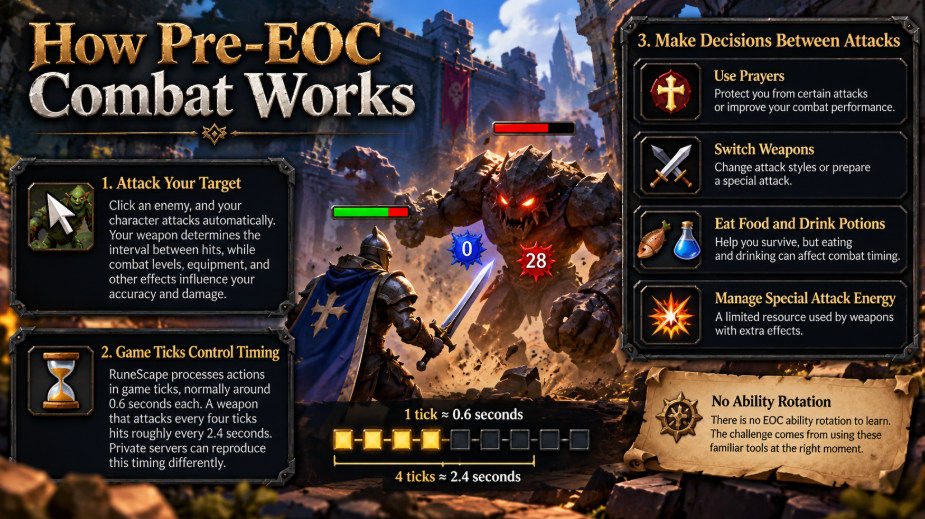
Click an enemy, and your character attacks automatically. Your weapon determines the interval between hits, while combat levels, equipment, and other effects influence your accuracy and damage.
RuneScape processes actions in game ticks, normally around 0.6 seconds each. A weapon that attacks every four ticks hits roughly every 2.4 seconds. Private servers can reproduce this timing differently, which is one reason two similar-looking games may feel different.
You make important decisions between attacks:
- Prayers protect you from certain attacks or improve your combat performance.
- Weapon switches let you change attack styles or prepare a special attack.
- Food and potions help you survive, but eating and drinking can affect combat timing.
- Special attack energy is a limited resource used by weapons with extra effects.
There is no EOC ability rotation to learn. The challenge comes from using those familiar tools at the right moment.
Why Pre-EOC PvP Still Rewards Timing
Competitive games test different skills. Counter-Strike players may know gaming sites such as https://www.csgopromocode.com/, but a Pre-EOC duel has little to do with aiming. Here, players watch health, change equipment, choose prayers, and save their strongest moves for the right moment.
A Simple Melee Fight Shows the Difference
Imagine two players using similar gear. One uses dragon claws immediately, while the other survives the special attack and heals. The first player has spent a large part of their special attack energy without finishing the fight.
The second player waits until the opponent’s health is lower, then switches to a finishing weapon. That doesn’t guarantee a win: accuracy, damage rolls, protection prayers, and the opponent’s reaction still matter. But it creates a better opportunity.
Three Things Beginners Should Learn First
- When to eat. Waiting too long can leave you within range of a strong special attack.
- When to switch prayers. Different weapons and combat styles may require a different response.
- When to save special energy. Using it just because the bar is full can waste your best chance to finish a fight.
Some servers offer safe duels, while others focus on Wilderness fights where death can cost items. Learn the local rules before risking expensive gear.
Special Attacks Make Weapons Useful in Different Ways
A special attack isn’t always about the biggest hit. In the original Pre-EOC system, weapons could provide different tactical effects.
| Weapon | What Its Special Attack Does | Why It Matters |
| Dragon claws | Delivers several rapid hits | Useful for a burst of damage, especially against a weakened opponent |
| Dragon scimitar | Can temporarily stop an opponent using certain protection prayers | Creates an opening for follow-up attacks |
| Dragon dagger | Attacks twice in quick succession | Offers a lower-cost way to attempt burst damage |
These examples explain why players carried more than one weapon. A regular weapon could handle steady damage, while another was saved for a particular moment.
Check a server’s special attack rules before assuming they match the old game. Modified damage, energy costs, or delays can completely change which weapons are useful.
Ancient Curses Changed High-Level Combat
The Ancient Curses prayer book arrived in December 2009. It is one of the strongest signs that a server is recreating a later Pre-EOC era rather than the original 2007 experience.
Soul Split: Damage That Heals You
Soul Split originally required 92 Prayer and completion of The Temple at Senntisten. It restored health based on damage dealt and could also affect an opponent’s Prayer in PvP.
There was a trade-off. Soul Split used the overhead prayer slot, so you could not keep it active alongside an ordinary protection prayer. Players had to decide when healing was worth the extra damage they might receive.
Turmoil: A Powerful Melee Boost
Turmoil required 95 Prayer in the original system. It increased melee effectiveness and could draw on an opponent’s combat statistics.
These prayers made high-level combat more demanding. Prayer points were a resource to manage, and switching at the wrong time could be costly. On a private server, check how Soul Split healing, prayer drain, and Turmoil bonuses work; developers may adjust them for balance.
Summoning Changed What Players Could Bring to a Fight
Summoning arrived in 2008. Instead of traveling alone, players could call familiars with different roles.
The Pack Yak is a useful example. As a Beast of Burden, it could hold extra supplies. For a long boss trip, more food and potions meant fewer returns to the bank. The Unicorn Stallion provided healing support, making it useful for players who needed to survive longer encounters.
Combat familiars could also contribute damage in activities that allowed them. This gave players a choice between storage, recovery, and combat support.
Not every familiar worked everywhere. Wilderness rules and other restrictions mattered in the original game, and private servers may use their own limits. A server saying it has “full Summoning” should offer more than familiar models that merely follow you.
Dungeoneering Connected Training to Powerful Gear
Dungeoneering launched in April 2010. Players explored Daemonheim’s dungeons, solved rooms, fought bosses, and earned tokens that could be spent on rewards.
The chaotic rapier became one of the best-known weapons connected to this system. It gave players a reason to train Dungeoneering rather than simply buying another sword from a regular shop.
Private servers handle chaotic equipment in different ways. One might recreate dungeon runs and token rewards. Another may put the same weapon in a shop or boss drop table.
Both approaches can be enjoyable, but they create different progression. If you want the 2011 experience, check how you obtain the gear, not just whether it appears on a feature list.
What Good Pre-EOC Bossing Looks Like
Classic combat did not make boss encounters simple. Players still needed the right prayers, supplies, positioning, and team coordination.
Nex, released in January 2011, is a useful example. Her original encounter had several phases with different attacks. Players needed to react to what was happening instead of standing still and dealing damage until she died.
Other familiar content includes the God Wars generals and the Corporeal Beast. Their names may appear in a server description, but that alone doesn’t tell you whether their mechanics are complete.
A useful test is to watch a real fight. Does the boss switch phases? Can attacks be avoided or answered with the right prayer? Do players need different equipment or roles? These details matter more than a long list of boss names.
Pre-EOC vs. OSRS vs. RuneScape 3
The three experiences share RuneScape’s roots, but they are not interchangeable.
| Feature | Late Pre-EOC (Around 2011) | Modern OSRS | RuneScape 3 |
| Core combat | Auto-attacks, prayers, special attacks | Classic-style combat, expanded with newer content | Modern ability combat plus Classic Combat option |
| EOC action bar | No | No | Yes in modern combat mode |
| Summoning skill | Yes | No | Yes |
| Ancient Curses | Yes | Not the original Ancient Curses book | Yes, with later changes |
| Dungeoneering skill | Yes | No | Yes |
| Main focus | 2010-2012 era systems and equipment | A separate game with ongoing updates | Modern RuneScape with newer systems |
Modern OSRS is not frozen in 2007. It has added new quests, bosses, regions, and Sailing, released in November 2025. Its combat remains closer to the old style, but its content has developed in a different direction.
Is RuneScape 3 Classic Combat the Same as Pre-EOC?
No. RuneScape 3 offers a Classic Combat option, formerly called Legacy Combat. The mode was renamed and changed in March 2026. It removes the regular ability rotation, but still works inside the modern game’s rules and balance.
A Pre-EOC private server instead attempts to recreate an earlier period. How closely it succeeds depends on its developers.
A 2011 Client Does Not Guarantee 2011 Combat
You may see servers described by client revision numbers such as 614, 667, or 718. Those numbers refer to technical versions associated with different RuneScape builds. They are not review scores or promises of accuracy.
A game may look like RuneScape from 2011 while using custom damage calculations, very high XP rates, or equipment from other eras.
This matters most in PvP. Even a small change in prayer timing or special attack delay can affect a fight. For PvM players, missing boss phases or different drop systems may be more noticeable.
Look for a server that explains its changes. “Pre-EOC” tells you the direction of the game, not exactly what has been recreated.
How to Choose a Pre-EOC Server
Different players need different things. A PvP-focused server may be great for duels but offer little questing. An economy server may take longer to progress but give equipment and drops more meaning.
Before downloading a client, compare these details:
| Check | Why It Is Important |
| Combat mechanics | Prayer switching, weapon speed, and special attacks determine how fights feel |
| Available activities | Confirm the bosses, Dungeoneering, Summoning, or PvP modes you actually want |
| Progression rates | Fast XP and easy shops create a different experience from slower training |
| Player activity | A PvP world needs opponents online when you play; PvM groups need available teammates |
| Updates and support | Recent notes and working support channels help you understand the project’s condition |
| Official downloads | Use the server’s verified website or community channel, not an unexpected file link |
A new RSPS can offer excellent combat even with a small community, but don’t take an advertised online count as proof of daily unique players. Try visiting during the hours you normally play.
Test the Combat Before Spending Hours Training
Your first session can answer most beginner questions:
- Fight a low-level enemy. Check attack speed, damage, and movement response.
- Try two combat styles. Switch between melee and Ranged or Magic to see whether the controls feel predictable.
- Test a special attack. Watch its energy cost and whether its effect matches the server’s description.
- Look at the Prayer book. Find out whether Ancient Curses are available and how they’re unlocked.
- Check one activity you came for. If you want Nex or Dungeoneering, confirm that the actual content exists rather than trusting a feature list.
For PvP, find a safe practice area if the server offers one. Check death and item-loss rules before entering the Wilderness.
Why Players Keep Returning to Pre-EOC
The appeal is more specific than nostalgia. Pre-EOC combines familiar point-and-click combat with tools that give players genuine choices: save a special attack or use it now, protect against damage or switch to Soul Split, bring a Pack Yak for supplies or a familiar for another purpose.
It also sits between two different experiences. OSRS has expanded its own version of classic combat, while RuneScape 3 has modernized its systems. Pre-EOC servers appeal to people who want the equipment, prayers, and progression of the years just before EOC.
That doesn’t mean every private server is a faithful recreation. Some mix eras, speed up progression, or add custom gear. Others leave parts of the original content unfinished. The right choice depends on which parts of the period matter to you.
Is Pre-EOC Worth Trying?
If you’re new to this era, start with a server that explains its mechanics and offers the activities you want. Test the combat before investing time in training or equipment.
The best reason to play Pre-EOC is the combat itself: simple attacks on the surface, with meaningful decisions hidden in prayer changes, weapon switches, and special attack timing. A good server lets those systems do the work.